


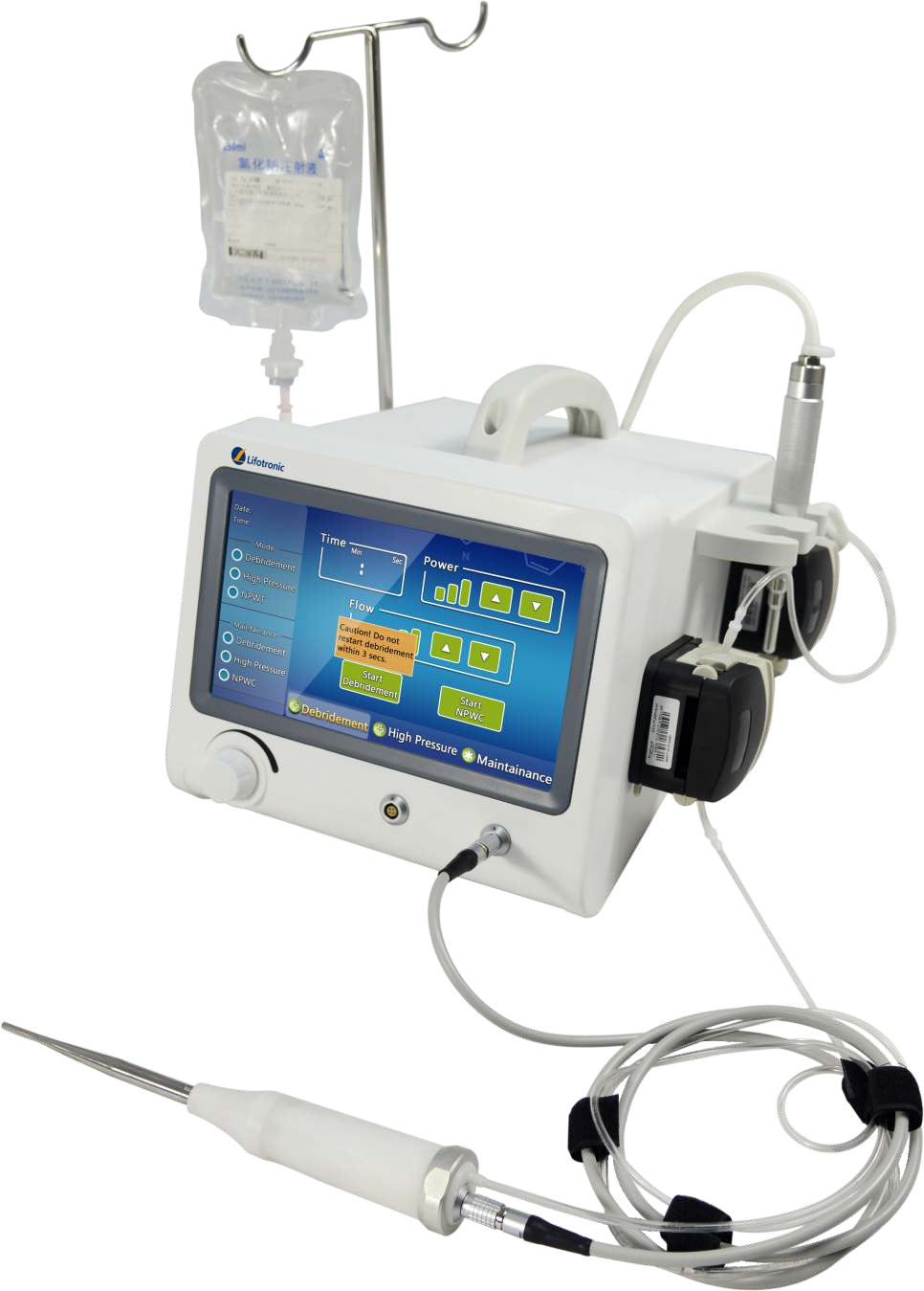
The Multifunctional Ultrasonic Debridement System is a normal medical device utilized in hospital departments such as Emergency Medicine, Burns, Trauma Surgery, and Chronic Disease Management. It is mainly used for the debridement and cleaning of acute and chronic complex wounds—including burns, diabetic foot ulcers, and postoperative wounds.
The PROMED Multi-functional Ultrasonic Debridement System combines “Ultrasonic Debridement + High-Pressure Pulsed Irrigation + Negative-Pressure Suction” into a single unit. Its key advantages include:
- Low Labor Costs—One Person and One Machine Suffice for Debridement—High Efficiency
- Enhanced Patient Experience — Painless or Minimally Painful Procedure + Large-Area Irrigation — Short Duration, Minimal Discomfort
- Wide Range of Applications—Complex, Hard-to-Heal Wounds, Including Burns, Diabetic Foot, Pressure Ulcers, Traumatic Injuries, Postoperative Wounds, and More.
- Versatile Functionality — Ultrasonic Cavitation Debridement + High-Pressure Pulsed Irrigation + Negative-Pressure Suction + Intelligent Temperature Control + Safety Protection Mechanisms
- Easy to operate — Can be operated by professional medical personnel who have undergone product training.
Traditional debridement includes cleaning and disinfection, excision of necrotic tissue, hemostasis, irrigation, and suturing; its disadvantages are:
- High Labor Costs — Traditional debridement requires the coordinated effort of multiple specialized medical personnel — Resulting in low efficiency.
- Poor Patient Experience — Debridement via Scalpel or Repeated Swabbing with Cotton Balls — Prolonged Debridement Time and Significant Patient Pain
- Limited Scope of Application — Incomplete Debridement of Deep Sinus Tracts and Fistulas — Increased Risk of Infection.
- Technical Limitations — Excessive debridement damages healthy tissue — prone to iatrogenic injury and delayed wound healing.
- Physician Competence — Difficulty Distinguishing Between Viable and Necrotic Tissue — Extreme Reliance on Physician Experience
Economic Benefits and Cost Control
The multi-functional ultrasonic debridement system reduces the consumption of pharmaceuticals and consumables — such as antibiotics, gauze, and cotton swabs — thereby alleviating the financial burden on patients.
The system’s ability to perform thorough debridement and promote wound healing helps reduce patient length of stay, accelerate hospital bed turnover, and enhance overall operational efficiency.
By precisely sparing healthy tissue, the system minimizes the risks associated with both excessive debridement (tissue loss) and insufficient debridement (recurrent infection), thereby reducing the likelihood of requiring secondary reconstructive procedures and lowering overall medical costs.
Optimizing Clinical Procedures and Healthcare Efficiency
The debridement process requires only a single device and one trained healthcare professional, thereby significantly reducing both hospital labor costs and patient discomfort.
Data indicates that, compared to traditional debridement—which entails at least 23 minutes for pre-operative preparation, intra-operative procedures, and post-operative care—the ultrasonic debridement system completes the entire process (from device startup through post-operative care) in approximately 16 minutes, resulting in a time savings of roughly 20%.
Standardized Procedures, Reduced Human Error
Traditional debridement relies heavily on a physician’s years of experience to identify and manually excise necrotic tissue—a process inherently susceptible to subjective error.
In contrast, the multifunctional ultrasonic debridement system doesn’t require subjective physician judgment. Because necrotic and healthy tissues possess distinct bioelectrical impedances, the system utilizes the ultrasonic cavitation effect to automatically differentiate between tissue densities. The procedure is executed simply by using the ultrasonic handpiece for irrigation and a negative-pressure suction tube for tissue removal, thereby reducing errors caused by human factors.
Purchasing this machine entails more than simply acquiring a piece of therapeutic equipment; it signifies the adoption of a comprehensive wound management solution—one centered on the patient, driven by precision treatment, and aimed at rapid recovery. Combining clinical indispensability with economic efficiency and technological sophistication, it represents an optimal investment for enhancing a hospital’s overall service capabilities.
If you are interested in the PROMED Multifunctional Ultrasonic Debridement System, please contact us at E-mail: info@llkmedical.com. Looking forward to working with you. Thank you.