


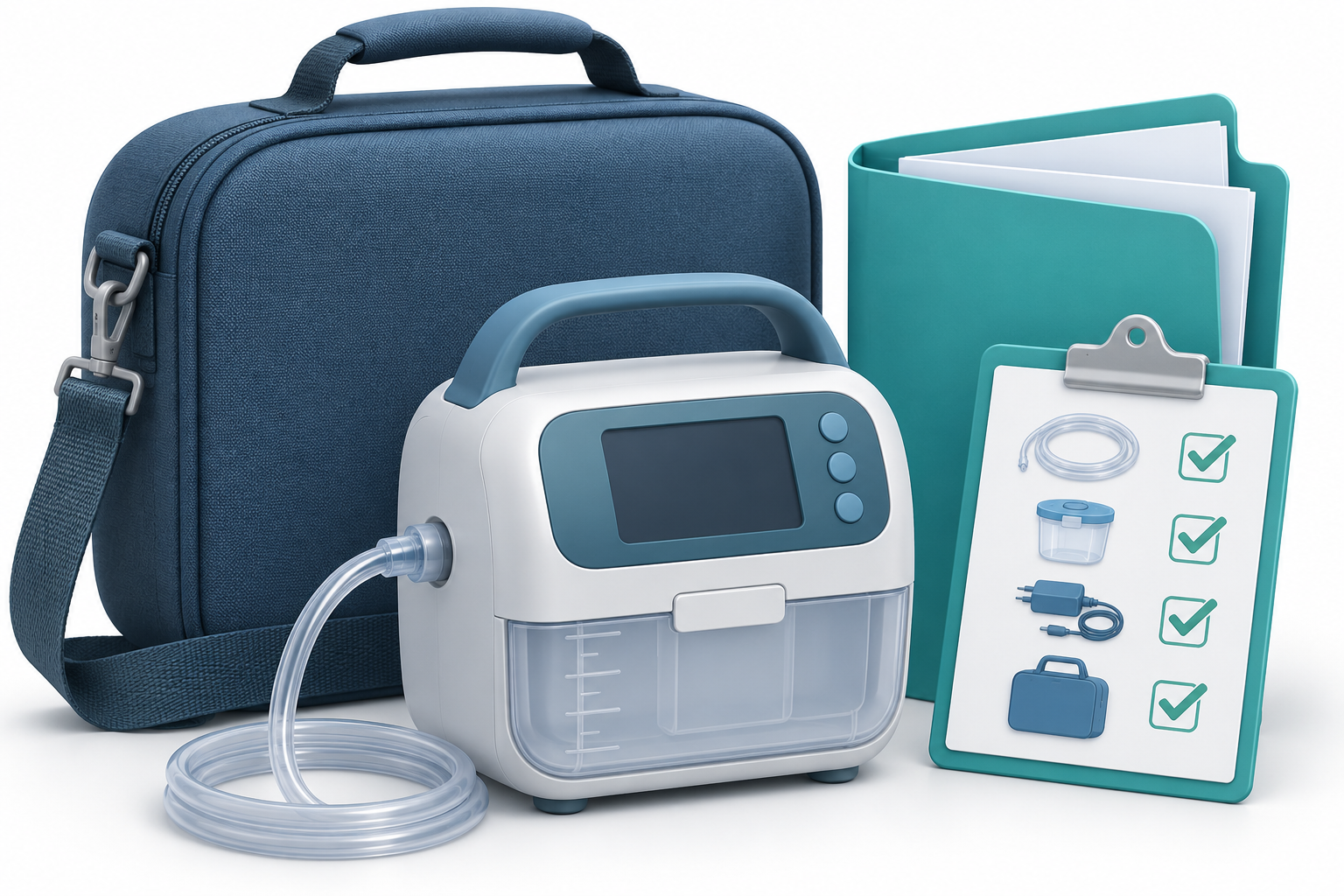
AI-generated educational illustration. It does not establish portability, home use, transport limits, or a real product configuration.
A compact NPWT device is not automatically portable for every setting. Your purchasing team should verify portability against the exact model’s IFU, approved configuration and target-market documents. Appearance, a carry case or a photo is not evidence of intended use.
Define “Portable” From Documents, Not Appearance
Different suppliers may use “portable,” “compact” or “mobile” differently. Start with the current IFU, label and market-specific documents for the exact model. They should tell you the intended-use context and the limits that apply to transport, power, accessories and consumables.
Do not convert a general product-family claim into an exact-model promise. This is especially important when a catalog contains several systems with different power arrangements, collection options or accessory sets.
Review the Complete Therapy Pathway
A portable form factor does not remove the need for a complete, documented pathway. At a general level, an NPWT system involves a negative-pressure source, a dressing or seal, a conduit and a collection component where used. FDA describes that framework in guidance limited to the non-powered NPWT category; it remains a useful reminder that the source alone is not the whole purchase.
Ask which dressing kits, tubing, connectors and collection components are approved for the quoted model. Require a dated compatibility list or other model-specific manufacturer evidence. Do not mix components based on physical resemblance or historical promotional images.
Check Power and Transport as Configuration Questions
Power arrangement, charging equipment, environmental limitations, carry accessories and instructions for transport are product-specific. A request for quotation should separate what is included from what is optional. It should also identify the document revision that governs safe handling and storage.
Avoid using a single headline number—such as battery duration or weight—as the whole comparison. The conditions behind those figures, their applicable model and their document source matter. If you cannot obtain current evidence, list the item as pending verification rather than repeating an unqualified marketing claim.
Plan Consumable Continuity Before Placing the Pump Order
The commercial viability of a
offer depends on more than the capital device. Buyers should map recurring consumables, pack sizes, lead times, expiry handling, minimum order quantities, target-market labels and replacement availability. A device that cannot be supplied with its approved consumables is not a complete offering.
Use a configuration table that ties each recurring item to the exact model, part number, documentary compatibility evidence and ordering status. Keep the table version controlled so it can be checked again when an IFU or supplier revision changes.
Confirm Service, Escalation and Market Readiness
Before launch, identify the support contact, complaint route, documentation-update process and any service restrictions. These details affect distributors, care organizations and procurement teams differently, but they should be resolved before a sales claim is made.
Regulatory status and authorized markets must also be confirmed separately. A brochure, an image or a reference to another country is not evidence that a device can be marketed in your destination. Obtain the current documents for the proposed model and market from the responsible manufacturer or authorized representative.
Questions to Include in an RFI
- What is the exact model and current IFU revision for our target market?
- Which consumables and accessories are approved with that model?
- What is included, optional or excluded in the proposed configuration?
- Which documents support the stated power, transport and storage information?
- How are IFU updates, complaints and technical support handled?
- What evidence supports market availability for the destination?
FAQ
Does a Small NPWT Pump Automatically Count as Portable?
No. “Portable” should be supported by the current intended-use and product documentation for the exact model, not inferred from appearance.
Can a Portable NPWT System Be Used in Every Care Setting?
Do not assume this. Confirm the setting and limitations in the current IFU and applicable local requirements.
What Should Be Compared Besides the Pump?
Compare the approved dressing-side pathway, collection components where used, power arrangement, recurring consumables, documents, support and target-market status.
Can We Use a Canister or Dressing From Another System?
Only if current manufacturer documentation explicitly supports the exact combination. Similar connectors or product-family names are not enough.
Is a Supplier Brochure Sufficient for a Market Claim?
No. Treat it as a lead. Confirm the current model-specific label, IFU and required target-market documentation before making a claim.
Conclusion
The useful question is not whether a system looks portable. It is whether the exact, documented configuration can be supplied, supported and marketed for the intended setting. Verify the entire pathway and its current documents before you commit to a launch. For current configuration documents, contact LLK Medical.
This page is for B2B product-selection discussion only. It does not provide clinical advice and does not establish the intended use, compatibility or market status of any specific product.
Sources
- U.S. FDA. Non-powered Suction Apparatus Device Intended for Negative Pressure Wound Therapy (NPWT), Class II Special Controls Guidance. Accessed 21 October 2026.