


NPWT procurement is more than a pump comparison. Buyers must verify the wound interface, fluid path and collection component where used. A complete quotation should identify each item and the current documents that support the proposed configuration.
Start With a System View
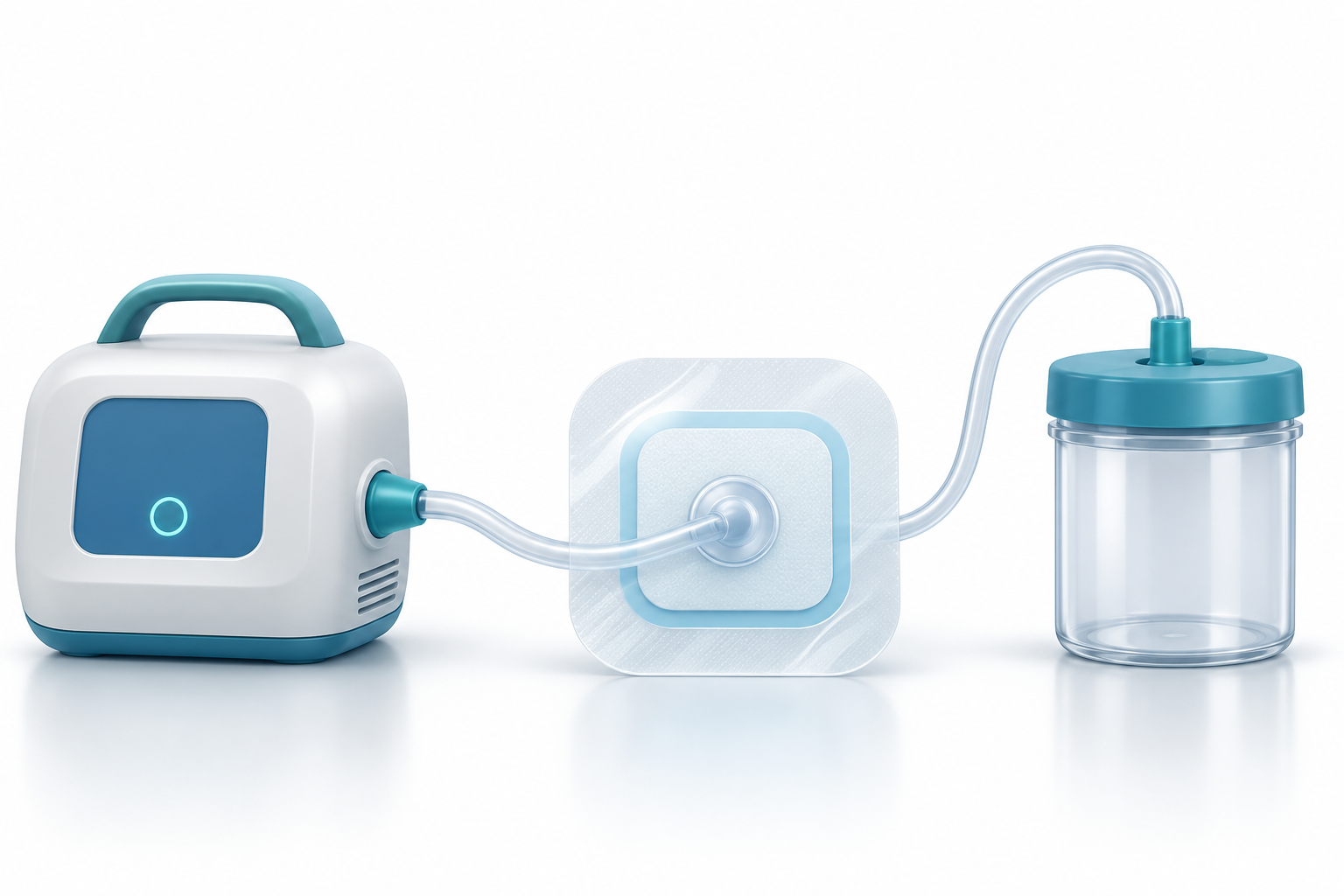
Negative pressure wound therapy (NPWT) is commonly discussed as a system, not as a single device. In its guidance for the non-powered NPWT device category, the U.S. FDA describes a general arrangement that includes a negative-pressure source, a dressing or seal, a conduit and a waste container. That description is useful as a buying framework, but it is not a universal bill of materials for every powered device or market.
For a real purchase, the current IFU, labels and approved accessory list for the exact model matter more than a generic diagram. Ask the supplier to identify what is supplied, what is optional and what has been validated together.
1. Negative-Pressure Source
The source supplies the negative-pressure pathway; the control function, if any, is model-specific. Depending on the product category, it may be an electrically powered pump or a non-powered apparatus. It is not enough to compare a headline pressure range. Your technical file should make clear the model, intended use, power arrangement where relevant, alarm or monitoring functions where applicable, and the documents that support the claims in the target market.
Do not assume two products with similar-looking connectors or a similar pressure range are interchangeable. A similarity in appearance is not compatibility evidence.
2. Wound Interface and Sealing Materials
The wound interface is the material placed within or over the wound area as part of the prescribed dressing configuration. A drape or other sealing material helps create the closed pathway needed for the system. These items may be packaged as a kit, sold separately or specified by size and use case.
For purchasing, confirm the exact part number, quantity, sterile status if applicable, packaging configuration, expiry information and the IFU section that names the component. The right question is not “does it look like foam?” but “is this item listed for use with this exact system and market version?”
3. Tubing, Connectors and Ports
Tubing links the dressing-side assembly to the source and, in many configurations, to the collection container. Connectors and ports are small parts with a large effect on system continuity. Different designs can look similar while having different locking, routing or approved-accessory requirements.
Request a component drawing or a labelled kit list. It should show which connector belongs at each interface and whether a component is single-use, reusable or supplied with another item. Do not create a mixed configuration from separate quotations unless the supplier can provide written compatibility evidence for the exact combination.
4. Canister or Other Collection Component
Where a system uses a canister, it collects exudate within the approved pathway. Capacity alone does not establish suitability. You also need to check the connection type, the relevant model list, overflow or change guidance in the IFU, disposal instructions and local waste-handling requirements.
If you are comparing canisters, keep the question narrow: “Which current pump model and which current dressing-side configuration is this canister approved to work with?” A historical product photo or a generic catalogue table is not a sufficient answer.
5. Accessories, Documents and Service Materials
Accessories can include power accessories, mounting options, carry solutions, connectors, fixation items or instructions. Their availability and status can change by market and configuration. The same is true of service documentation, training scope and replacement-parts support.
Before you request samples, ask for a dated configuration sheet that separates standard items, optional items and exclusions. Match that sheet against the quotation, the IFU revision, labels and any market-specific documentation you will rely on.
A Practical Verification Checklist
Use a simple four-column list for every proposed configuration:
- Exact identity: model, accessory part number and document revision.
- Role in the pathway: source, interface/seal, tubing/connector or collection component.
- Compatibility evidence: current IFU, approved accessory list or manufacturer statement that names the combination.
- Commercial status: supplied, optional, excluded, minimum order and replacement availability.
This is a procurement control, not a clinical protocol. Dressing selection, application and patient management must remain with trained clinicians following the current IFU and local requirements.
FAQ
What Are the Main NPWT Components?
At a general level, buyers will usually review the negative-pressure source, the wound interface and seal, tubing or connectors, and a collection component where the system uses one. The actual contents depend on the exact product and market documentation.
Is an NPWT Pump Compatible With Any Canister or Dressing?
No. Compatibility should be demonstrated in the current manufacturer documentation for the exact combination. Similar shape, connector size or historical product photography is not enough.
Are Dressings and Tubing Always Included With the Pump?
Not necessarily. They may be sold as kits, options or separate consumables. Ask for a dated packing list and quotation that clearly states inclusions and exclusions.
What Documents Should a Distributor Request?
Start with the current IFU, labels, approved accessory or compatibility list, product specification, configuration/packing list and relevant target-market documentation. Confirm document revision and intended market before relying on them.
Can This Article Be Used as a Dressing-Application Guide?
No. It is a buying and documentation guide. Clinical application must follow the current device IFU, the care setting’s procedure and trained clinical judgment.
Conclusion
The safest NPWT comparison starts with the complete pathway, not the pump alone. If you are evaluating a configuration, request current model-specific documents and match every quoted item to its approved role before placing an order. For model-specific configuration documents, contact LLK Medical.
This page is for product-selection and documentation discussion only. It is not clinical advice or a substitute for the current IFU, local procedure or qualified clinical judgment.
Sources
- U.S. FDA. Non-powered Suction Apparatus Device Intended for Negative Pressure Wound Therapy (NPWT), Class II Special Controls Guidance. Accessed 21 October 2026.