


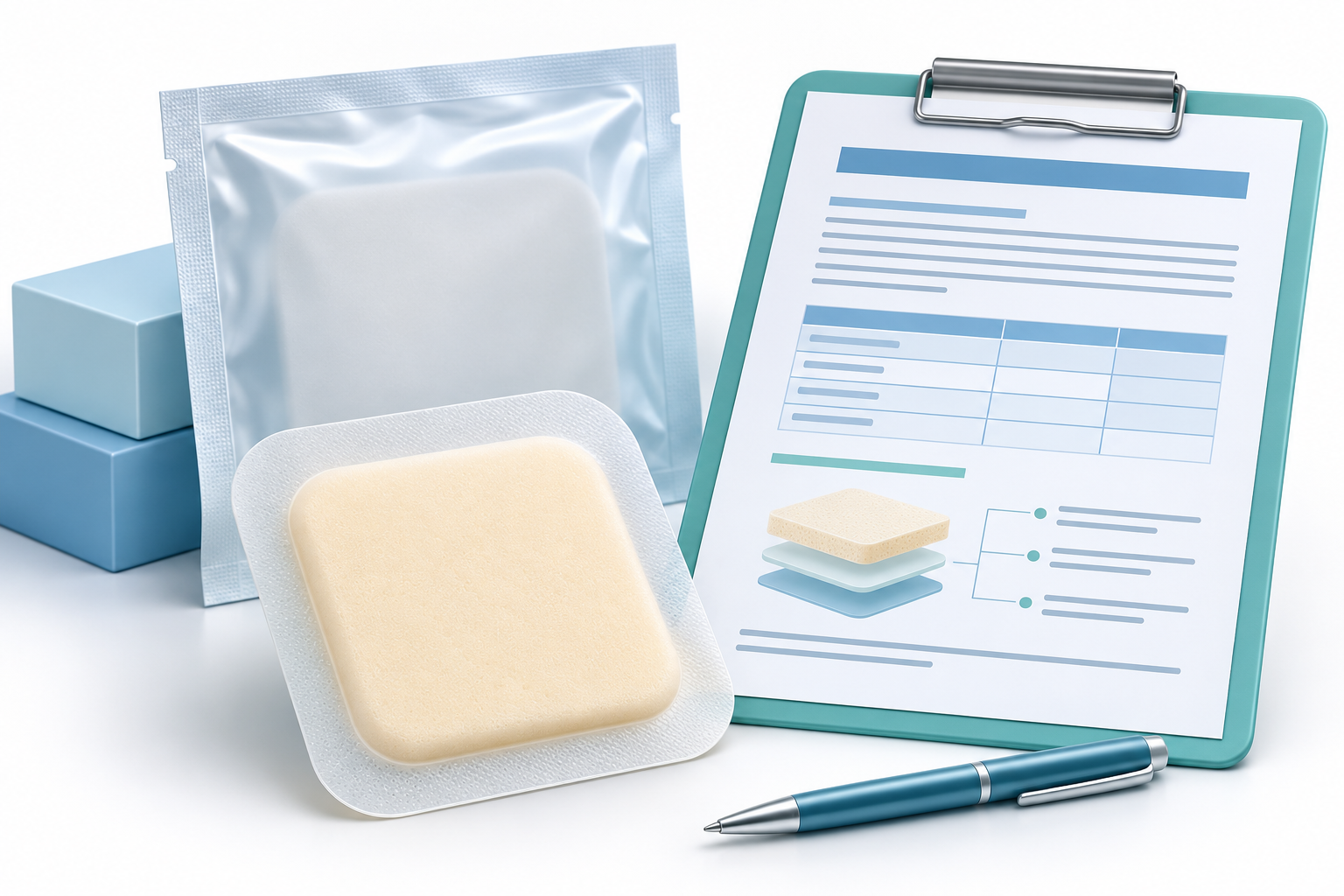
Foam wound dressing is a broad product category, not a single specification. Your procurement team should compare the current product documents, packaging and intended-use information before comparing price. A product photo or a generic material name is not enough to establish performance or compatibility.
Start With the Exact Product Identity
Ask for the exact product name, part number, document revision and target-market label. The product specification should identify the material description, dimensions, packaging and sterile status where applicable. If a supplier uses terms such as “high absorption” or “gentle,” ask which current document defines the claim and for which product version.
Do not transfer a statement from one foam product to another. Foam dressings can differ in construction, contact layer, backing, adhesive design, thickness and intended use. These distinctions affect the questions a clinical team needs answered, even when two products look similar in a catalogue.
Separate Clinical Selection From Procurement Control
The choice of a dressing for an individual wound belongs to qualified clinicians using assessment, local procedure and the current product instructions. EWMA’s dressing guidance emphasizes assessment and matching products to the wound-management objective rather than choosing by category name alone.
Your role in procurement is to make that clinical decision possible with traceable supplies. Confirm that the product data, labels, shelf-life information, storage conditions and available sizes match the request. Do not present a commercial comparison table as a treatment recommendation.
Do Not Confuse General Foam With an NPWT Kit
Some foam items are conventional dressings; others may be part of a named negative-pressure wound therapy configuration. They should not be treated as interchangeable. If a supplier proposes a foam item for a system, request written evidence in the current exact-model IFU or approved accessory list.
The evidence should identify the part number and the system version, not merely show a photograph of a pump and a foam pad. Physical appearance, colour or pore pattern is not compatibility evidence.
Compare Packaging and Supply Continuity
For each SKU, record unit of supply, pack quantity, label language, expiry and storage requirements, minimum order quantity, lead time and complaint contact. These details often determine whether an item can be sustained through a distributor program.
Sample evaluation should also be controlled. Record what was supplied, the revision of the documents provided and any open questions. This prevents an unrecorded substitution between evaluation and repeat purchase.
Questions for Your Supplier
- What is the exact SKU and current document revision?
- What are the labelled dimensions, packing and sterile status, if applicable?
- What intended-use and performance statements are supported for this market?
- Is this a conventional dressing or an approved component of a named system?
- What current document supports any proposed system pairing?
- How will supply changes and updated instructions be communicated?
FAQ
Are All Foam Wound Dressings the Same?
No. Material construction(silver dressing,PVA white dressing,PU foam dressing and so on), contact layer, backing, adhesive features, packaging and intended use may differ. Compare the exact product documents rather than the category name.
Can a Foam Dressing Be Used With Any NPWT System?
No. A proposed pairing needs current manufacturer documentation for the exact product and system. Similar appearance is not evidence of compatibility.
What Should a Distributor Request Before Quoting?
Request current labels, IFU or instructions, specification, packing list, target-market documents and written compatibility evidence where a system pairing is proposed.
Does This Article Recommend a Dressing for a Specific Wound?
No. Clinical selection requires assessment and qualified clinical judgment. This page is a product-documentation and supply comparison guide.
Why Does Packaging Matter?
Pack quantity, label language, shelf life, storage and traceability affect ordering, inventory control and the ability to compare a sample with a repeat order.
Conclusion
Compare foam wound dressings as documented products, not as look-alike materials. Match each quotation to its current product file and, where relevant, its approved system relationship. For documentation and configuration questions, contact LLK Medical.
This page is for B2B product-selection discussion only. It does not provide clinical dressing-selection advice or establish the performance or compatibility of a specific product.
Sources
- European Wound Management Association. Home Care Wound Care Clinical Decision-Making. Accessed 21 October 2026.