


NPWT dressing application depends on clinical judgment, the device-specific IFU and an approved consumable configuration. Buyers and distributors should verify that these elements can be supplied and documented together. This page is a procurement guide, not a clinical application protocol.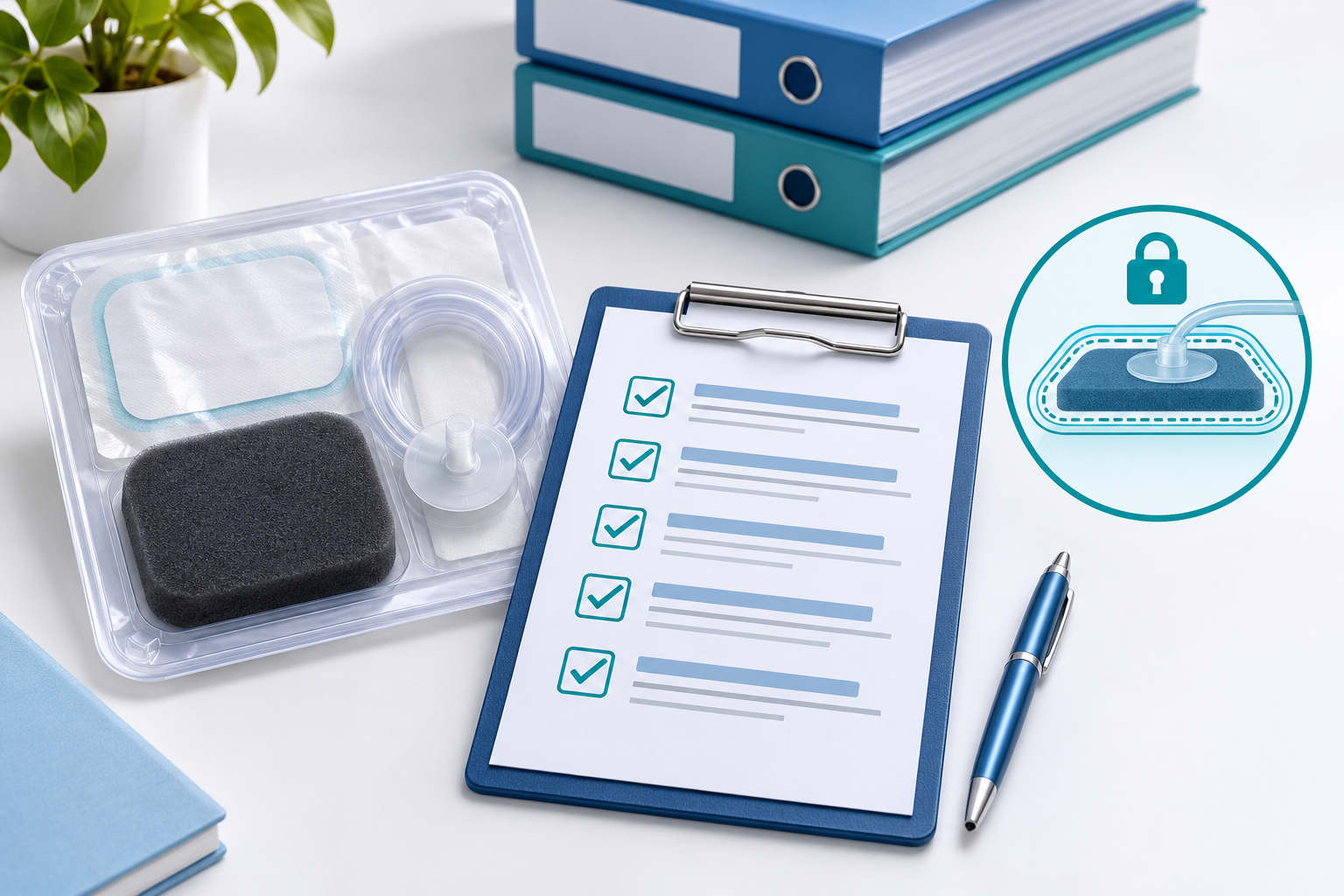
AI-generated educational illustration. It is not a clinical application instruction or a real product kit.
Why a Generic Application Guide Is Not Enough
The dressing-side configuration is part of the treatment pathway. The exact sequence, materials, warnings and follow-up requirements may differ by device, dressing type, intended use and market. A video, a historical catalogue image or an instruction for another system cannot establish that a configuration is appropriate for the product you are purchasing.
FDA guidance for the non-powered NPWT category describes the general relationship between the negative-pressure source, dressing or seal, conduit and collection component. It is helpful for understanding why the pathway must be complete. It is not a substitute for the current IFU for a powered or non-powered model.
What Your Procurement Team Should Verify Before an Order
Begin with a controlled configuration list. It should name the pump or source, dressing-side kit, seal materials, tubing or connector, collection component if used, and any accessories included in the quotation. Each line should have a part number, document revision and stated commercial status: supplied, optional or excluded.
Then ask for the current IFU and the approved accessory list for the target market. The document should make it possible to confirm the intended pairing. If a supplier cannot identify the document that supports a proposed combination, treat the combination as unverified rather than “probably compatible.”
Training Belongs in the Delivery Plan
A product handover should distinguish clinical training from commercial familiarisation. Clinical users need the level of training and oversight required by their organization, current IFU and local rules. A distributor may need product-identification, storage, traceability and escalation training, but that does not qualify it to prescribe or improvise clinical application.
Ask what training material is current, which product revision it covers, who may deliver it and how updates are communicated. Training records, model identifiers and version-controlled instructions reduce the risk that a team follows an outdated configuration.
Check the System Interface, Not Just the Dressing Box
The dressing pack itself may be sterile, non-sterile, single-use or supplied in a particular size assortment; these facts must be checked on the actual label and IFU. The rest of the pathway also needs review. A connector, a canister, a drape or a power accessory should not be treated as a universal interchangeable item because it looks familiar.
During a sample evaluation, document exactly what was supplied. Record product names, lot and expiry data where relevant, kit contents, label language, IFU revision and open compatibility questions. This makes it much easier to compare a sample with the eventual purchase order and to identify a configuration change before clinical use.
Build an Escalation Route Before Launch
Procurement documents should identify who answers product questions, how technical complaints are logged, how updated IFUs are distributed and what happens when a quoted component is unavailable. This is particularly important for recurring consumables: a pump purchase without an approved and documented consumable route can create a continuity risk.
Keep the boundary clear. A commercial team can help collect documents and route technical questions; it should not provide patient-specific advice. Any clinical concern, alarm, dressing issue or deviation from the IFU should go through the care organization’s established clinical and manufacturer-support process.
A Concise Procurement Checklist
Before approving an NPWT dressing configuration, verify:
- The exact model and destination market.
- The current IFU and label revision.
- The complete quoted consumable list and each part number.
- Written evidence for the proposed system pairing.
- Training scope, update control and technical escalation contact.
- Supply continuity for the approved consumables.
FAQ
Can a Distributor Use This Article to Train Clinicians to Apply an NPWT Dressing?
No. This article addresses documents and procurement controls. Device application must follow the current IFU, local procedure and qualified clinical training.
Is a Dressing Kit Compatible With Every NPWT Pump?
No. Confirm compatibility for the exact combination in current manufacturer documentation. Similar packaging or connectors do not establish approval.
What Should Be Included in a Sample-Evaluation Record?
Record the product and part numbers, document revision, supplied contents, labels, any relevant lot/expiry data and unresolved compatibility or market-document questions.
Are Training Slides Enough to Support a Purchase Decision?
They can be useful context, but current IFUs, labels, approved accessory lists and target-market documents should control the decision.
Who Should Answer a Clinical Application Question?
The trained clinical team should follow its procedure and current IFU, using the manufacturer’s designated technical or clinical support route where appropriate.
Conclusion
For NPWT dressing application, the purchasing question is whether the exact system can be documented, supplied and supported as a coherent configuration. Keep clinical application with qualified teams, and require current model-specific evidence before approving a kit. For configuration-document requests, contact LLK Medical.
This article is for procurement and documentation discussion only. It does not provide clinical application instructions or replace the current IFU, local procedure or qualified clinical judgment.
Sources
- U.S. FDA. Non-powered Suction Apparatus Device Intended for Negative Pressure Wound Therapy (NPWT), Class II Special Controls Guidance. Accessed 21 October 2026.